Product successfully added to your shopping cart

Ho Yan Hor 何人可
The Ho Yan Hor Story: From $4 Street Stall to Global Pharmaceutical Empire
Introduction: A Cup of Liquid Gold
For generations of Malaysians, the dark, bittersweet taste of Ho Yan Hor herbal tea has been synonymous with relief from fever, flu, and the tropical heat. What many don't realize is that every sachet contains not just 24 carefully selected herbs, but a remarkable story of vision, perseverance, and family legacy that spans over eight decades.
The journey of Ho Yan Hor—from a humble street stall in Ipoh to a publicly listed pharmaceutical company with products in over 50 countries—is one of Malaysia's most inspiring entrepreneurial tales. At its heart is Dr. Ho Kai Cheong, a man whose unwavering determination to help others transformed a $4 investment into a household name trusted by millions .
Part One: The Making of a Healer (1910-1941)
Early Years in Kati
Ho Kai Cheong was born on July 11, 1910, in Kati, a small mining village near Kuala Kangsar, Perak . His parents were Chinese immigrants, and his father ran a coffee shop selling dim sum. From an early age, young Ho helped out in the family business, learning the rhythms of trade and service. But despite acquiring skills in Chinese pastry-making, he felt no desire to continue in the coffee shop trade .
At just eight years old, Ho was sent to China to further his education—a common practice among immigrant families of that era . He studied for two years at Tsung Wah Chinese primary school in Kuala Kangsar before the journey abroad. When he returned to Malaya at fourteen, he knew instinctively that his future lay elsewhere.
Finding His Calling
Rather than return to his father's coffee shop, the teenager found employment at a Chinese medical hall. The world of traditional herbs and remedies captivated him completely. He proved so adept at this new vocation that within just three years—at the age of seventeen—he had saved enough to open his own Chinese medical shop in Kuala Kangsar .
But fate had other plans. In 1934, driven by patriotic fervor, Ho made the momentous decision to close his business temporarily and join the Chinese army to fight against Japanese invasion. He was stationed in Humen, Guangdong, when the town came under attack. Forced to flee, Ho made his way to Hong Kong, where a new chapter would begin .
Formal Training
In Hong Kong, Ho enrolled at the prestigious Canton Wah Lam National Physician's School, determined to transform his practical experience into formal medical knowledge . He threw himself into his studies with characteristic intensity, graduating on Christmas Eve of 1940—a fully qualified Chinese physician .
Armed with his new credentials, Ho returned to Malaya in 1941. But the world he came back to was on the brink of chaos. Soon after his arrival, the Japanese invaded, and Malaya would endure three and a half years of occupation .
Part Two: Humble Beginnings (1941-1945)
A Doctor Without Payment
Throughout the occupation, life was brutal for ordinary people. Medicine was scarce, and the sick and elderly suffered terribly. Despite having few resources himself, Dr. Ho Kai Cheong dedicated himself to helping those around him, often treating patients without accepting any payment . It was during these dark years that he began developing the herbal formula that would eventually become his legacy.
Drawing on his training and knowledge of traditional Chinese medicine, he experimented with combinations of local herbs, searching for a remedy that could effectively treat the common cold, fever, and body heatiness that plagued so many. The result was a unique concoction of 23 or 24 specially chosen herbs (sources vary slightly on the exact number) .
Love and Partnership
Amidst the hardship, Ho found love. He married Koo Soo Lian in 1942 in a simple ceremony that reflected the difficult times . Their partnership would prove essential to everything that followed. While Ho focused on perfecting his formula and treating patients, his wife provided steadfast support, managing their home and eventually helping with the business.
The couple would later be blessed with six children—four daughters and two sons—creating the family foundation upon which a future business empire would be built .
The Mentor's Advice
When the British returned in September 1945, Malaya began the slow process of recovery. Tin miners returned to work in droves, and the streets of Ipoh came alive again. It was around this time that Ho met Yew Song Pak, a man who would become both friend and mentor .
Ho confided his dream of opening a medical hall to continue helping others, but admitted he lacked the capital. Yew's response would change everything:
"Young man, there are big ways for big business and small ways for small business. Likewise, big capital for setting up a medical factory, medium capital for a medical hall and small capital for a medical stall. If you don't have much capital, then brew your herbal tea and sell it by the roadside. You'll be helping others that way too" .
Taking this advice to heart, Ho used the last four dollars in his pocket as working capital .
Part Three: The Street Stall Years (1945-1947)
Five Cents a Glass
Ho began brewing small batches of his herbal tea in the kitchen of his rented home at No. 1 Treacher Street (now Jalan Bijeh Timah) . Each evening at 5pm, he would set up a simple wooden stall right in front of the building and sell his dark, bitter brew for just five cents per glass .
His target customers were the tin miners and laborers returning home exhausted after long days working under the sun and rain. Suffering from "body heat" and susceptible to colds, they were exactly the people Ho had formulated his tea to help .
The response exceeded all expectations. On that very first night, every drop sold out within an hour .
Word Spreads
Within a remarkably short time, Ho's humble stall became the most prominent among the many pushcarts lining bustling Treacher Street. He increased production steadily, yet every night, thirsty customers continued to line up. Word about the therapeutic herbal tea spread rapidly through the community, and soon people were traveling from as far away as Kampar and Batu Gajah—towns more than 20 kilometers distant—just to taste it .
At the peak of this period, Ho was selling an extraordinary 1,200 glasses of tea every single night .
The Cycling Entrepreneur
During the day, while his wife managed the stall, Ho embarked on a different mission. Loading his bicycle with boxes wrapped in brown paper, he became a traveling salesman, pedaling from village to town, from Perak to Penang and all the way to the borders of Kedah .
This earned him the nickname "The Bicycle Entrepreneur" or "Cycling Herbal Tea Entrepreneur"—a testament to his tireless efforts to bring his remedy to as many people as possible . He visited coffee shops and medical halls throughout Malaya, introducing his tea packets to new customers in Kuala Lumpur, Melaka, Penang, and even Changloon near the Thai border .
Part Four: Innovation and Growth (1947-1957)
The Tea Bag Revolution
In 1947, Ho had a breakthrough idea. Why not sell his herbal tea in dried form, conveniently packaged in sachets? This innovation would allow customers living further away to prepare the tea at home simply by adding hot water .
The concept was revolutionary. Ho Yan Hor became the FIRST company to develop Chinese herbal tea in tea bag form for easy consumption . This innovation earned its founder the title "King of Herbal Tea" .
To implement his new idea, Ho needed more space. He successfully negotiated with his landlord to rent the entire shophouse at No. 1 Treacher Street, transforming his former home into a proper production facility .
Marketing Genius
Ho understood the power of advertising long before it became standard practice for local businesses. In 1948, he saved enough to purchase his first vehicle—a Morris Minor Tourer . Three years later, he upgraded to a Fordson van for product delivery .
But these weren't just delivery vehicles. Ho plastered their sides with colorful images of his product and catchy slogans, turning them into mobile billboards. He fitted vans with loudspeakers to broadcast his message. Recognizing the immense popularity of Cantonese opera and Hong Kong movies among Chinese communities in the 1950s and 1960s, he partnered with famous opera singers and film stars to promote his tea .
He invited celebrities like actress Tang Pik Wan and TVB heartthrob Cheng Gwan-Min (known as the "Elvis Presley of the East") to visit his factory, generating priceless publicity . A talented calligrapher himself, Ho personally wrote many of his early advertisements, ensuring they conveyed both the health benefits and the authentic Chinese heritage of his product .
Moving to Larger Premises
By 1954, business had grown so rapidly that the Treacher Street premises could no longer keep pace. Ho purchased a three-acre plot of land on Jalan Kuala Kangsar and built his first proper factory . Here, a team of 25 workers prepared the herbal mixture using the same meticulous traditional methods Ho had developed in his kitchen.
Despite the expansion, Ho insisted on maintaining quality. Every batch was prepared just as he had done in those early days—a principle that remains central to the brand today .
The 1957 Flu Pandemic
The Asian Flu pandemic of 1957 swept across East Asia before spreading worldwide, eventually killing an estimated one to two million people . As western medicine struggled to cope, many turned to traditional remedies. Ho Yan Hor herbal tea, with its proven effectiveness against colds and flu, became one of the most sought-after household brands throughout Malaya .
This crisis cemented Ho Yan Hor's position as a trusted name in healthcare—a reputation that would endure for generations .
Part Five: The Visionary's Legacy Plan (1970s-1980)
Planning for Succession
Ever the visionary, Dr. Ho Kai Cheong understood that lasting success required planning beyond his own lifetime. He looked to his children, particularly his eldest son David Ho Sue San, and made a crucial decision: David would be trained as a pharmacist to professionalize and expand the family business .
In the 1970s, David was sent to New Zealand to pursue pharmaceutical science . He would go on to complete a Master's degree and spend two years in the United Kingdom as a research pharmacist, gaining invaluable experience in Western pharmaceutical practices .
Father and Son
When David returned home, he found his father initially cautious about the changes he proposed. The younger Ho began introducing machines to process herbs more efficiently, bringing in professionals to provide fresh perspectives, and gradually modernizing operations while carefully maintaining quality .
It took several years for the results to become visible, but as the restructuring began bearing fruit, Dr. Ho recognized the wisdom of his son's approach. In 1980, he officially passed the reins of the company to David—a transition that would transform the traditional herbal tea business into a global pharmaceutical enterprise .
Part Six: The Hovid Transformation (1980-2005)
A New Direction
Under David Ho's leadership, the company embarked on an ambitious new chapter. In 1981, Hovid Pharmacy was incorporated in Malaysia, marking the official entry into mainstream pharmaceuticals . The vision was clear: leverage traditional knowledge while embracing modern science to create a truly world-class pharmaceutical company.
Research and Development Excellence
The 1990s saw Hovid emerge as a pioneer in pharmaceutical research and development:
Hovid became the FIRST to develop the self-emulsifying "SupraBio System" for improved absorption of palm tocotrienols in the human body, enhancing absorption by up to 300% .
International Recognition
The company's commitment to quality attracted international attention:
-
2001: Hovid Inc incorporated in the Philippines; Hovid R&D project published in the International Journal of Pharmaceutics
-
2005: Publicly listed on the second board of Kuala Lumpur Stock Exchange (KLSE) under the name Hovid Berhad
Part Seven: A Global Pharmaceutical Partner (2006-Present)
Continuing Innovation
The new millennium saw Hovid's reputation continue to grow:
Today, Hovid manufactures and distributes more than 400 products across 50 countries, holding 1,504 marketing authorizations worldwide .
Quality Without Compromise
Hovid's facilities in Ipoh and Chemor, Perak, meet the highest international standards. The Chemor plant underwent a RM45 million expansion to meet pharmaceutical production standards of Europe, US FDA, and Australian TGA .
The company's quality control laboratories are ISO/IEC GUIDE 25 certified, and its manufacturing facilities conform to PIC/s, cGMP, and GLP guidelines . Hovid has been inspected by more than 100 health authorities worldwide, including the US Food and Drug Administration and Singapore's Health Sciences Authority .
Research Commitment
With 40 professional scientists, Hovid's R&D team has completed 62 self-conducted bioequivalence studies, launching an average of 16 products per year with 114 products currently in development . The Attest Research Centre in Penang ensures that new products meet rigorous quality, efficacy, and safety requirements .
Part Eight: The Man Behind the Legacy
A Life of Achievement
Dr. Ho Kai Cheong's remarkable life continued well beyond his business success. After retiring at 81, he pursued theology in Hong Kong, graduating with a doctorate in divinity in 1997 at the age of 87 .
Throughout his life, he remained committed to helping others. A generous philanthropist, he supported numerous local causes and gave back to the communities that had supported his business .
Dr. Ho Kai Cheong passed away on January 11, 2007, at the age of 97 . He left behind not just a successful company, but an enduring example of what determination and compassion can achieve.
Awards and Recognition
Hovid's excellence has been recognized through numerous awards:
Part Nine: The Ho Yan Hor Museum
Preserving History
In 2016, David Ho undertook a remarkable project: restoring the original family shophouse at 1, Jalan Bijeh Timah, Ipoh, and transforming it into the Ho Yan Hor Museum . The restoration took 10 months and was managed by Ian Anderson, a retired Royal Naval Commander who had fallen in love with Ipoh's history .
The building's striking blue façade, adorned with white scalloped eaves and traditional Chinese architectural features, immediately distinguishes it from surrounding pre-war shophouses . On its side wall, a black and white mural by Ernest Zacharevic—part of the Art of Old Town series—depicts tin mining dredges, honoring both the street's name (Jalan Bijeh Timah means "Tin Lane") and Ipoh's heritage .
A Journey Through Time
Visitors enter to find a replica of Dr. Ho's original street stall, positioned exactly where it stood in the 1940s . A life-sized cutout shows the "Cycling Entrepreneur" with his vintage Japanese bicycle, laden with tea packets .
The museum offers a carefully curated experience:
Ground Floor:
-
The faithfully recreated kitchen where Ho perfected his recipe, complete with period cooking equipment, rattan drying trays, and vintage food tins
-
Exhibits displaying the 23-24 herbs that make up the original formula
-
Traditional Chinese medicine pharmacy recreated as a 1940s dispensary
Upper Floor:
-
Promotional materials handwritten by Ho himself in elegant Chinese calligraphy
-
Photographs of early marketing vehicles, including the Fordson E494C and Volkswagen combi vans with vibrant liveries
-
Vintage tea packets showing the evolution of packaging designs
-
Displays documenting the company's growth through seven decades
An Authentic Experience
Throughout the museum, exhibits are presented in trilingual captions (English, Malay, and Chinese) . Visitors can learn about traditional Chinese medicine practices, see antique production equipment, and understand the health benefits of various herbs .
The highlight for many comes at the end: a complimentary cup of Ho Yan Hor tea, brewed the traditional way using the original recipe, served in the very building where it all began .
Visitor Information
The museum has become a must-visit destination for anyone interested in Ipoh's history, traditional Chinese medicine, or simply an inspiring story of entrepreneurial success .
Part Ten: The Herbal Tea Today
Product Line
Ho Yan Hor continues to innovate while honoring tradition. Today's product line includes:
-
Ho Yan Hor Original Herbal Tea: The classic formula, effective for relieving body heat and common cold symptoms
-
Gold Herbal Tea: Premium blend for enhanced benefits
-
Good Night Tea: Formulated to promote restful sleep
Quality Assurance
All Ho Yan Hor products are manufactured in GMP-certified facilities, ensuring consistent quality and safety . The same commitment to excellence that drove Dr. Ho Kai Cheong continues to guide production today.
Global Reach
From its origins on a street corner in Ipoh, Ho Yan Hor has grown to reach consumers in over 50 countries worldwide . Yet despite this global presence, the brand remains deeply connected to its Malaysian roots and the values of its founder.
Conclusion: A Legacy of Goodness
The name "Ho Yan Hor" carries a beautiful meaning: "Providing Goodness to Everyone" . This philosophy, embedded in the brand from its very beginning, continues to guide everything the company does.
Dr. Ho Kai Cheong's story is more than just a business success—it's a testament to the power of vision, hard work, and genuine care for others. From a young man with four dollars and a dream, to a globally recognized healer and entrepreneur, his journey continues to inspire.
As a signboard at the museum states: "Nothing has stopped Dr Ho from achieving his dreams and helping others. May this legend inspire you to fulfill your dreams and contribute positively to the community" .
Today, when someone sips a cup of Ho Yan Hor tea—whether in Kuala Lumpur, Hong Kong, London, or Los Angeles—they're tasting not just herbs, but the legacy of a man who believed that even with limited resources, one person could make a difference in the lives of many.
The next time you're in Ipoh, take time to visit the little blue shophouse on Jalan Bijeh Timah. Walk through the museum, taste the tea brewed exactly as it was in 1945, and let the story of Dr. Ho Kai Cheong remind you of what's possible when determination, compassion, and vision come together.
After all, as his mentor once told him: "There are big ways for big business and small ways for small business." Dr. Ho Kai Cheong chose his way—and changed the world, one cup of tea at a time .
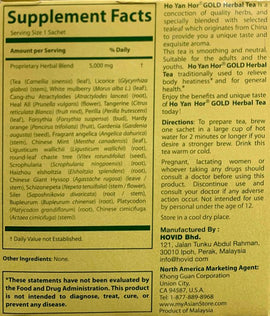
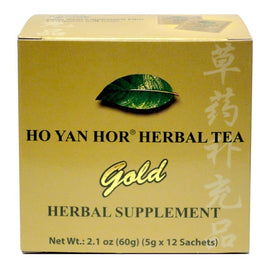
Ho Yan Hor Gold Herbal Tea (何人可 GOLD 涼茶) – 12 SachetsBalance and cool your body with a cup of Ho Yan Hor Gold Tea....